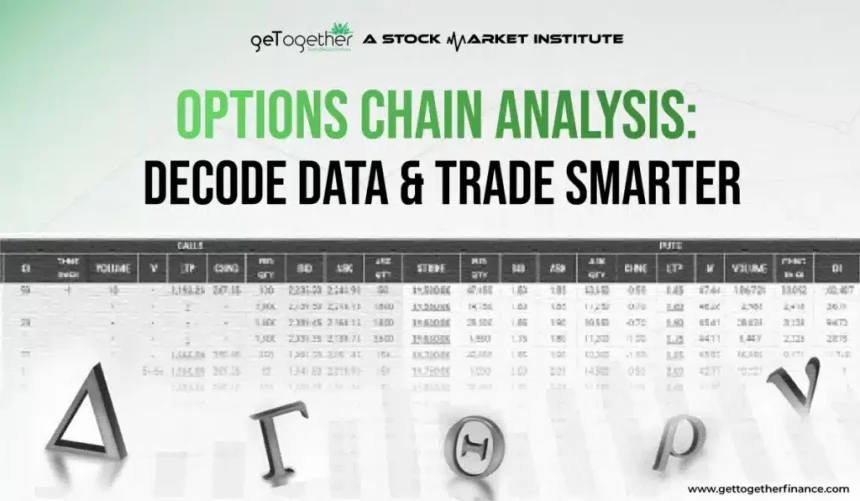
Entering the world of derivatives can feel completely overwhelming if you are relying purely on basic stock charts. Many active participants look at a standard price graph, assume a trend will continue upward, and buy a call option, only to watch their premium melt away hours later. The problem isn’t necessarily that the direction was wrong; it’s that they ignored the underlying forces of market sentiment and implied volatility. To avoid these blind spots, serious traders move past standard price charts and spend their time analyzing the option chain matrix. It provides a real-time, mathematical look at exactly where institutional money is placing its bets.
Reading the Market’s Mind Through Open Interest
Before placing your next trade, you need to understand that the option chain is essentially a scoreboard showing the battle between option buyers and option writers. Most retail participants act as buyers, but the big institutional players—the ones with the capital to move markets—are usually the ones writing (selling) the contracts.
When you open a comprehensive share market app, the option chain displays a metric called Open Interest (OI) for every strike price. By tracking where the highest concentrations of OI sit on both the call side and the put side, you can identify major psychological barriers. High call OI tells you exactly where big institutional writers are capping the market, forming a heavy resistance zone. Conversely, massive put OI highlights where the smart money is willing to step in and support the price. Instead of guessing where an asset will drop or rally, analyzing these data clusters gives you an objective roadmap of market boundaries.
Tracking Implied Volatility to Avoid Premium Traps
Another critical metric embedded directly inside the option chain layout is Implied Volatility (IV). Think of IV as a fear gauge for a specific stock or index. It reflects the market’s expectation of a massive, impending price swing, usually ahead of major corporate earnings or macroeconomic announcements.
- High IV Scenarios: When IV spikes, option premiums become incredibly expensive. If you buy options during these peak periods, you risk a phenomenon known as an “IV crush,” where the premium collapses immediately after the event occurs—even if the stock moves in your predicted direction.
- Low IV Scenarios: When IV is exceptionally low, option premiums are cheap, making it a much friendlier environment for net buyers looking to capture sudden, explosive breakouts.
Advanced dashboards, such as the one on HDFC Sky F&O platform, integrate real-time option chain data with built-in payoff analyzers and scanners. This level of technological clarity prevents you from accidentally buying overpriced contracts, allowing you to gauge the cost-to-risk ratio before deploying capital.
Building a Unified Financial Sandbox
The biggest mistake a modern investor can make is limiting themselves to just one financial instrument. Active traders who engage in high-frequency f&o trading often make the mistake of keeping their short-term speculative capital completely separate from their long-term wealth engines.
The smartest market participants don’t isolate their strategies. Instead, they use integrated platforms that allow users to easily invest in F&O, Mutual Funds, and domestic equities under one single roof. Using a single, seamless share market app ensures that your core wealth continues to compound safely in stable mutual fund schemes while your active, short-term satellite capital is utilized for tactical derivative plays. This dual approach gives you complete control over your overall net worth without forcing you to toggle between multiple confusing broker accounts.
Transitioning From Speculation to Strategy
At the end of the day, successful trading isn’t about chasing random rumors or relying on pure luck. It requires a systematic approach to reading institutional footprints.
By downloading a robust, data-centric share market app and dedicating time to mastering option chain analytics, you stop gambling on price direction and start trading alongside market probabilities. Use your safe buckets to anchor your long-term security, and use advanced tools to execute calculated, high-conviction f&o trading setups when the data aligns in your favor. Knowing how to read the fear and greed of the crowd through numbers is what ultimately separates a professional practitioner from an emotional hobbyist.