Introduction: India’s Business Landscape Is Entering a Technology-Driven Era
AI in Indian business has moved decisively past the pilot-project stage. What started as scattered chatbot experiments and isolated automation projects a few years ago is now showing up in core operations across sectors — and the funding numbers back that up. Indian AI startups raised roughly $676 million in the first half of 2026 alone, more than four times what they raised in the same period the previous year, even as overall Indian startup funding actually declined during the same stretch. That divergence says a lot about where investor conviction is heading.
Fintech continues reshaping how businesses and consumers interact with financial services, from fraud detection to credit assessment, while DeepTech is quietly building real momentum in semiconductors, advanced computing, robotics, and other technology-intensive sectors that used to be considered too capital-heavy for the Indian market to compete in seriously. What’s genuinely new is that these three forces — AI, fintech, and deep tech — are no longer separate stories. Understanding how AI is reshaping India’s business landscape increasingly means understanding how all three are converging and beginning to influence established businesses, not just startups. This article walks through exactly how.
1. AI Is Moving From a Tool to a Business Infrastructure
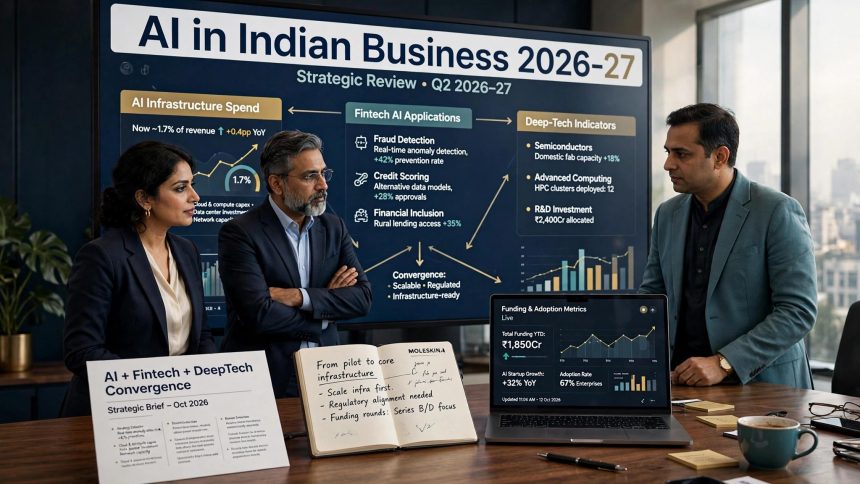
Generative AI and AI agents were largely experimental additions to Indian businesses as recently as two years ago — a chatbot bolted onto a website, an AI-written first draft here and there. That’s changing quickly. Enterprise AI adoption is accelerating fast enough that Boston Consulting Group’s 2026 AI Radar report found Indian companies planning to spend about 1.7% of revenue on AI this year, more than double the increase planned for the previous year, with 88% of Indian business leaders optimistic about seeing positive returns.
This is exactly how artificial intelligence is changing Indian businesses at a structural level. AI-powered decision-making, automation of routine workflows, and genuine AI infrastructure investment — data centers, compute capacity, model deployment — are becoming board-level priorities rather than side experiments run by a single innovation team. Businesses are moving beyond simple chatbot experimentation because the earlier pilots proved the technology’s value enough to justify real infrastructure spend behind it.
2. Indian Startups Are Building AI-Native Products
The most interesting shift isn’t just how many startups are raising AI-related funding — it’s what kind of companies they are. AI-first startups building industry-specific applications, enterprise AI tools, AI-powered SaaS, and customer service automation are increasingly common, and Indian-language AI in particular represents a genuinely underexplored opportunity given the country’s linguistic diversity.
This is central to how AI startups are changing Indian industries from the ground up. The deal count tells its own story: AI startup funding deals in India surged 90% year-on-year to 57 deals in the first half of 2026, a level of activity that marks a real shift in venture capital appetite toward frontier technology rather than the consumer-app-heavy funding cycles of a few years ago.
3. Fintech Is Becoming More Intelligent
AI is quietly transforming how fintech companies operate across fraud detection, credit assessment, customer support, financial personalization, risk management, and financial forecasting. India’s AI-in-fintech market itself was valued at roughly $690 million in 2025 and is projected to grow at nearly 19% annually through 2034, driven by the country’s expanding digital payments infrastructure and rising demand for intelligent fraud-prevention systems.
This growing sophistication is a clear example of how fintech is transforming Indian businesses well beyond simple digital payments. Machine learning models are now doing meaningful work in lending and wealth management that used to require large teams of analysts — accelerator programs specifically backing AI-based financial solutions have emerged in the past year to help scale this shift further across early-stage fintech companies.
4. AI and Fintech Are Expanding Financial Inclusion
Digital financial services powered by AI are reaching customers who traditional banking infrastructure has historically underserved. Alternative data sources — mobile usage patterns, transaction history, utility payments — combined with automated financial assistance are giving more Indians access to credit and financial products than conventional credit-scoring models ever allowed.
This matters enormously for the future of AI and fintech in India, particularly outside major metro areas where formal credit history is often thin or nonexistent. Personalized financial services built on this kind of alternative data genuinely expand access, but it comes with a real responsibility: regulatory compliance and responsible technology use have to keep pace with innovation, or the trust that makes financial inclusion work in the first place erodes quickly.
5. DeepTech Is Moving From Research Labs Into Industry
Semiconductors, robotics, drones, advanced computing, space technology, and even early quantum computing work are shifting from academic and government research settings into genuine commercial activity. India’s cumulative deep tech investment has reached approximately $28 billion over the past decade, according to a report released by the India Deep Tech Alliance at the India AI Impact Summit in February 2026 — a figure that reflects deep tech’s graduation from a niche allocation into a core pillar of India’s broader economic strategy.
This is precisely how deep tech is changing India’s business landscape in ways that go beyond software. DeepTech companies tend to require significantly greater capital, deeper technical expertise, and considerably longer development cycles than a typical consumer app or SaaS business — which is exactly why the scale of recent commitment matters. Industry alliance members have pledged more than $2.5 billion over five years toward AI and deep tech, with $1 billion earmarked specifically for AI deployment over the next three years.
6. AI Infrastructure Will Become a Strategic Business Priority
Data centers, computing capacity, cloud infrastructure, and AI chips are increasingly treated as strategic assets rather than back-office IT line items. AI’s share of total venture capital funding in India climbed from 4.5% in 2020 to 12.3% in 2025 — nearly a threefold increase in five years — even as overall VC deployment held roughly steady at around $10 billion annually across 2024 and 2025.
Data availability, cybersecurity, and genuine infrastructure investment are all becoming board-level concerns for companies serious about AI adoption trends among Indian businesses. A company that hasn’t thought through where its AI models run, how customer data is secured, and whether its compute capacity can actually scale is building on a foundation that won’t hold up once AI moves from pilot to production across the organization.
7. Traditional Industries Will Adopt AI and DeepTech
This shift isn’t confined to startups and technology companies. Manufacturing, healthcare, financial services, retail, logistics, agriculture, automotive, and energy are all beginning to adopt AI and deep tech applications suited to their specific operational needs — predictive maintenance on factory floors, AI-assisted diagnostics in healthcare, demand forecasting in retail and logistics.
Understanding how Indian businesses can benefit from AI means looking past generic productivity tools toward sector-specific applications that solve a genuine operational problem. A logistics company doesn’t need the same AI infrastructure as a healthcare provider — the value comes from matching the right application to the actual business need, not from adopting AI broadly for its own sake.
8. The New Competitive Advantage Will Be Technology + Talent
As AI tools become more widely accessible, the differentiator is shifting from who has access to the technology toward who can actually use it well. An AI-skilled workforce, genuine technical leadership, data literacy across teams — not just in a specialized AI department — and deliberate upskilling of existing employees are all becoming competitive necessities rather than nice-to-haves.
Human and AI collaboration, done thoughtfully, tends to outperform either pure automation or pure manual process. Recruiting specialized DeepTech talent — engineers with genuine semiconductor, robotics, or advanced-manufacturing expertise — has become notably harder as demand has outpaced the available talent pool, which is pushing companies toward more deliberate internal training programs rather than relying purely on external hiring.
9. Businesses Will Need to Balance Innovation With Risk
None of this growth comes without real risk that businesses need to take seriously. Data privacy, cybersecurity, AI hallucinations and factual errors, algorithmic bias, and evolving regulatory compliance requirements are all genuine concerns as AI adoption accelerates across Indian business.
Responsible AI practices and clear governance frameworks matter enormously for maintaining customer trust as these technologies become more embedded in day-to-day operations. A business that rushes AI deployment without addressing these risks isn’t actually ahead of the curve — it’s accumulating problems that tend to surface at the worst possible moment, usually in front of a customer or regulator.
10. What These Trends Mean for Indian Businesses in 2027
Pulling this together into something practical, here’s what businesses evaluating these AI business trends in India should actually do:
- Identify where AI can solve a real problem — rather than adopting technology for its own sake.
- Start with measurable use cases — pilot before scaling company-wide.
- Invest in data and infrastructure — the foundation that makes AI adoption sustainable long-term.
- Train employees — building internal AI and data literacy, not just hiring specialists.
- Monitor technology and regulatory developments — this space is moving fast, and staying informed is now a genuine business function.
- Build responsible AI practices — governance that protects customer trust as adoption scales.
- Evaluate fintech and DeepTech opportunities relevant to their sector — rather than assuming these trends only apply to technology companies.
Staying Updated With India’s AI and Technology Ecosystem
As AI, fintech, and DeepTech continue to evolve, businesses need reliable sources to monitor emerging technologies, funding activity, infrastructure developments, and market trends. Malik Times provides coverage across AI, startups, funding, and technology developments, making it a useful resource for readers following India’s evolving technology ecosystem, from financial AI and infrastructure investment to semiconductor developments and emerging AI platforms.
Conclusion: AI, Fintech and DeepTech Will Shape the Next Phase of Indian Business
AI will keep influencing how Indian companies operate, make decisions, and compete, moving well beyond the experimental pilots that defined its early adoption. Fintech will continue reshaping financial services and business transactions, expanding access even as it demands more careful governance. DeepTech, still capital-intensive and slower-moving than software, can create genuine opportunities in strategically important technology sectors for businesses and investors willing to play a longer game. The companies that come out ahead won’t simply be the ones that adopted these technologies first — they’ll be the ones that combined real technology adoption with skilled talent, responsible governance, and strong execution. India’s business landscape is entering a genuinely technology-driven era, and the businesses paying close attention now are the ones most likely to be shaping it, rather than reacting to it, by the time 2027 is fully underway.
Frequently Asked Questions (FAQs)
1. How is AI reshaping India’s business landscape? AI is moving from experimental pilots into core business infrastructure — powering decision-making, automation, and customer-facing applications across sectors, backed by a sharp rise in enterprise AI investment and startup funding through 2026.
2. How much are Indian companies investing in AI in 2026? Indian companies are planning to spend roughly 1.7% of revenue on AI in 2026, more than double the increase planned the previous year, according to Boston Consulting Group’s 2026 AI Radar report, with the large majority of Indian leaders optimistic about positive returns.
3. How is fintech being transformed by AI in India? AI is improving fraud detection, credit assessment, financial personalization, and risk management across Indian fintech, with the AI-in-fintech market projected to grow at nearly 19% annually through 2034 as digital payments infrastructure expands.
4. What is deep tech, and why is it growing in India? Deep tech covers capital-intensive, technically complex sectors like semiconductors, robotics, advanced computing, and space technology. India’s cumulative deep tech investment has reached around $28 billion over the past decade, reflecting its shift from a niche sector to a core economic priority.
5. How are AI startups changing Indian industries? AI-native startups are building industry-specific applications, enterprise AI tools, and AI-powered SaaS products. Funding activity reflects this shift clearly — AI startup deal count surged 90% year-on-year in the first half of 2026, even as broader startup funding declined.
6. Can AI improve financial inclusion in India? Yes. AI-powered alternative credit scoring and automated financial assistance are helping extend credit and financial services to customers traditional banking has historically underserved, particularly outside major metro areas.
7. What risks should Indian businesses consider when adopting AI? Key risks include data privacy, cybersecurity vulnerabilities, AI-generated errors or hallucinations, algorithmic bias, and evolving regulatory requirements. Responsible AI governance is essential to maintaining customer trust as adoption scales.
8. How is AI infrastructure investment changing in India? AI’s share of total Indian venture capital funding rose from 4.5% in 2020 to 12.3% in 2025, with major industry commitments — including $2.5 billion pledged by the India Deep Tech Alliance over five years — reflecting infrastructure’s growing strategic importance.
9. Which traditional industries in India are adopting AI and deep tech? Manufacturing, healthcare, financial services, retail, logistics, agriculture, automotive, and energy are all adopting AI and deep tech applications suited to their specific operational needs, from predictive maintenance to AI-assisted diagnostics.
10. How can Indian businesses prepare for AI-driven transformation in 2027? Businesses should identify real problems AI can solve, start with measurable pilot use cases, invest in data and infrastructure, train employees on AI literacy, monitor regulatory developments, and build responsible AI governance before scaling adoption company-wide.