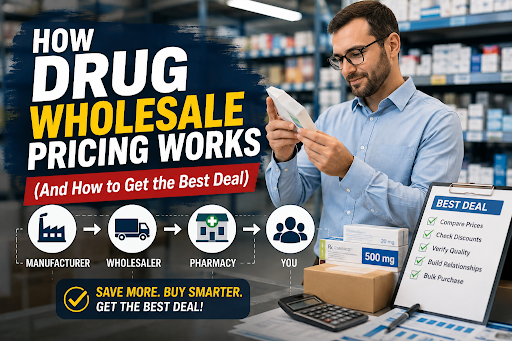
Every pharmacy owner, hospital procurement officer, and independent buyer who has reviewed a drug wholesale invoice has made the same assumption: the price on the page is the price in the market. It is not. The numbers printed across wholesaler catalogs — the figures that wholesale drug distributors use as the basis for contracts, tenders, and purchase orders — are not market prices. They are opening positions in a negotiation most buyers do not know they are in.
Understanding how wholesale drug distributors build their pricing — and where the real price hides — is not a compliance exercise. It is the single highest-leverage financial skill a procurement decision-maker can develop. The gap between what is published and what is paid runs into the hundreds of billions annually. That gap does not disappear. It flows somewhere. Knowing where it flows is how you stop funding other people’s margins with your own budget.
The Price Tag on Every Drug Is Not a Price — It’s a Starting Gun
WAC — Wholesale Acquisition Cost — and AWP — Average Wholesale Price — dominate drug procurement conversations. Both are set by the manufacturer. Neither reflects what buyers actually pay.
AWP functions identically to a car dealership’s MSRP sticker: a number engineered to anchor negotiations high so that every “discount” feels like a win, regardless of where the real transaction lands. The critical misconception among smaller buyers and independent pharmacies is that AWP represents market consensus — a price discovery mechanism. It is not. It is a manufacturer publication that pricing services like MediSpan and Red Book redistribute as if it were objective data.
The scale of the fiction is quantifiable. The gross-to-net bubble — the gap between what manufacturers publish and what they actually receive — reached a record $356 billion in 2024, exceeding the annual GDP of Denmark. That is not a rounding error in the system. That is the system.
This gap was not an accident of market complexity. It was deliberately structured by a distribution architecture that benefits intermediaries — PBMs, GPOs, and large wholesalers — who extract value from the space between list price and net price. The buyer at the end of that chain is, by design, the last to understand how that space was carved up.
How the Gap Is Engineered — The Four Layers of Hidden Discounting
The invoice a buyer receives reflects one price. Between that price and the manufacturer’s actual net revenue, at least four distinct discount mechanisms operate simultaneously.
The Four Discount Layers Decoded
Layer 1 — Manufacturer Rebates: Payments made by the manufacturer directly to PBMs in exchange for favorable formulary placement. They never appear on the buyer’s invoice, do not reduce the price the buyer pays, and can represent 20–30% of a brand drug’s WAC.
Layer 2 — Chargeback Mechanisms: When a wholesaler sells a drug below WAC, the manufacturer reimburses that wholesaler electronically for the difference. Whether any portion of that credit reaches the end buyer depends entirely on contract language — language most buyers have never audited.
Layer 3 — Prompt-Pay Discounts: Short-window payment incentives — typically 1–2% off invoice for remittance within 10–15 days — buried in contract appendices and routinely unclaimed by smaller buyers who lack the accounts payable infrastructure to act on them.
Layer 4 — Distribution and Admin Fees: GPOs and large wholesalers charge administrative fees as a percentage of purchase volume for access to contracted pricing tiers. These fees reduce the manufacturer’s net revenue without reducing the price the end buyer sees — a private toll on the distribution channel.
Wholesalers operate on a 2–6% surface margin. Yet the total discount architecture above that margin can represent 20–40% off WAC — a spread that moves almost entirely through intermediaries before a smaller buyer ever sees their invoice.
Why NADAC Is the Closest Thing to a Real Price — And How to Use It
NADAC — National Average Drug Acquisition Cost — is the only publicly available benchmark built from actual pharmacy invoice data rather than manufacturer publications. Compiled through CMS surveys of real pharmacy transactions and updated weekly, it reflects what pharmacies are genuinely paying drug wholesale distributors across thousands of products.
A buyer can pull the current NADAC figure for any formulary drug and place it directly against their contracted price. The difference quantifies, in real time, how far above market they are operating. This baseline audit — straightforward to execute, almost universally skipped — frequently surfaces 8–15% pricing gaps on high-volume generics.
One structural limitation must be understood: NADAC reflects retail pharmacy invoice prices, not the deeper institutional pricing available to large GPO members or integrated hospital systems. It is a floor reference, not a ceiling ambition.
Use it as opening evidence, not a final target. Walking into a wholesaler negotiation with a NADAC comparison signals that you understand real acquisition costs — and that you will not negotiate against a fiction.
The Three Structural Moves That Actually Close the Gap
Getting a better deal from wholesale drug distributors is not a negotiation skill problem. It is a structural positioning problem. These moves change the conditions under which you negotiate.
Move 1 — Request Chargeback Transparency
Standard wholesaler contracts do not itemize what portion of manufacturer chargeback credits are passed to the buyer versus retained by the distributor. This is not an oversight — it is a default that favors the wholesaler.
A formal written request for a chargeback reconciliation report — detailing, line by line, the credits received by the wholesaler on your contracted SKUs and the amount passed through — is within the rights of any buyer under a direct purchasing contract. This single request routinely surfaces 2–5% in recoverable savings requiring no renegotiation, only correct application of existing terms.
Move 2 — Concentrate Volume to Manufacture Leverage
Splitting purchases across multiple distributors to manage supply risk feels prudent. It systematically destroys pricing leverage. Wholesalers tier their discounts by committed volume. A buyer distributing $2M across three distributors qualifies for entry-level pricing with all three. That same buyer concentrating $1.6M with a primary wholesaler and $400K with a secondary qualifies for mid-tier pricing with their primary — and retains a credible competitive alternative that keeps that relationship honest at every renewal.
The secondary relationship is not a backup. It is the threat.
Move 3 — Time Purchases to Manufacturer Rebate Cycles: Manufacturers reset rebate and promotional pricing on quarterly and annual cycles. Wholesalers receive advance notice. Buyers who request notification of upcoming promotional windows on their highest-volume SKUs access short-window discounts never proactively advertised. Savings on high-volume generics during these windows can reach 5–12% for a single purchase cycle.
What a Transparent Wholesale Partner Actually Looks Like
Most buyers, once they understand the pricing architecture above, realize they have never evaluated their wholesale relationship against transparency criteria — only against invoice price.
A genuinely transparent wholesale drug distributor proactively discloses chargeback pass-through rates without requiring a formal audit request. They benchmark pricing against NADAC on demand, without friction. Their contracts do not impose minimum order thresholds that force over-purchasing to maintain discount tier qualification. Their agreements do not penalize buyers for splitting volume during shortage periods — because a partner confident in their value does not need punitive lock-in clauses to retain your business.
These are not premium features. They are baseline standards that buyers should demand at the opening of any wholesale relationship, not concessions negotiated toward after the contract is signed.
The Buyer Who Understands the Architecture Always Wins
The drug wholesale pricing system was not designed with the buyer’s margin in mind. It was designed around the margins of the intermediaries who built it. Opacity is only an advantage for the other side as long as buyers accept it.
Drugzone Pharmaceuticals Inc. was founded on a different premise. As an NABP-accredited, FDA-registered generic pharmaceutical distributor licensed in all 50 states, Drugzone combines 80+ years of collective leadership experience with a transparent, partner-first operating model. With 2,000+ SKUs, direct manufacturer relationships across 75+ partners, and a compliance infrastructure built to DSCSA 2025 standards, Drugzone delivers the pricing clarity and supply reliability buyers should expect — but rarely receive. Explore what a transparent wholesale partnership looks like at Drugzone.com.
Frequently Asked Questions
- If WAC and AWP are not real prices, why do wholesalers still use them as the basis for contracts?
Because they are structurally useful to the wholesaler, not to you. AWP establishes a high anchor from which discounts are calculated — the wholesaler controls the reference frame of every negotiation. A buyer who accepts AWP as the baseline agrees to measure savings against a number never meant to reflect market value. The correct reference for any generic drug negotiation is NADAC, built from actual invoice data. Insisting on NADAC-benchmarked pricing resets the negotiation to a factual foundation.
- Are chargeback credits legally required to be passed through to the buyer?
Not automatically. Pass-through depends entirely on contract language. Most standard wholesale contracts permit the wholesaler to retain a portion as margin. The leverage is contractual, not regulatory: buyers who negotiate explicit chargeback pass-through language into their agreements and request periodic reconciliation reports recover credits that would otherwise remain with the distributor. If your current contract is silent on chargebacks, that silence is costing you money.
- How often should a buyer audit contracted pricing against NADAC, and what triggers an immediate review?
Conduct a formal NADAC comparison at minimum quarterly, covering the top 20 SKUs by purchase volume. Three conditions should trigger an immediate off-cycle review: a sudden spike in invoice price on a high-volume generic; a manufacturer-announced WAC increase (which does not automatically justify a proportional net price increase); and any contract renewal within 90 days. In each case, a current NADAC pull provides the factual basis to challenge a price movement before new terms are locked.