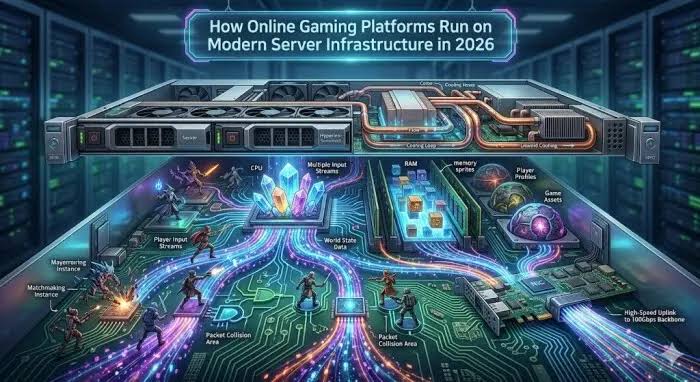
The modern digital casino landscape has transformed dramatically over the past decade. Where online slots were once powered by simple client-side scripts and hosted on isolated physical servers, today’s titles operate on complex distributed computing architectures. As game studios push the boundaries of visual fidelity with real-time 3D rendering, cinematic bonus rounds, progressive jackpots, and complex math models, the technical load on back-end infrastructure has scaled exponentially.
Players today demand instant game loading, zero frame drops, and flawless transactional accuracy regardless of whether they are playing on a high-end desktop or a mid-range smartphone via mobile data. Behind this smooth, uninterrupted experience lies a foundational breakthrough: modern cloud server technology.
By replacing rigid legacy hardware with elastic, cloud-native infrastructure, game developers have solved the persistent technical bottlenecks, latency spikes, and system crashes that once plagued digital slot machines. Understanding how cloud infrastructure operates behind the scenes reveals why modern online slot games achieve unprecedented stability and glitch-free performance.
The Legacy Infrastructure Bottleneck: Why Old Slots Glitched
To appreciate the impact of modern cloud architecture, it is essential to understand the structural limitations of legacy server setups that previously caused visual lag, loading freezes, and server dropouts.
On-Premise Physical Servers and Fixed Capacity
Historically, online slot platforms hosted their game engines on dedicated physical servers located inside private data centers. These servers operated with fixed hardware capacity meaning CPU cores, RAM allocations, and network bandwidth were strictly capped.
When game traffic remained predictable, physical servers performed adequately. However, digital gaming traffic is inherently volatile. Peak evening hours, weekend promotions, or the launch of a highly anticipated game title often caused sudden surges in concurrent active users. When traffic exceeded the physical server’s capacity, processing pipelines jammed, leading to:
- HTTP 504 Gateway Timeouts: The server became overwhelmed and stopped acknowledging incoming data packets.
- Frozen Reel Animations: The client interface froze mid-spin while waiting for the server to process Random Number Generator (RNG) calculations.
- Session Dropouts: Players were unexpectedly disconnected from active bonus features, requiring manual balance reconciliations.
Geographic Latency and Network Hops
Physical data centers exist in fixed geographic locations. If a game server was physically located in Europe, players connecting from Southeast Asia or South America experienced severe network latency. Data packets had to traverse dozens of international internet exchanges and undersea fiber-optic cables to complete a single spin handshake.
This multi-hop routing delay resulted in high ping rates (often exceeding 200–300 milliseconds), causing noticeable input lag whenever a user pressed the spin button or triggered an interactive Feature Buy option.
The Core Pillars of Modern Cloud Architecture in Slot Gaming
Modern cloud platforms such as Amazon Web Services (AWS), Google Cloud Platform (GCP), and Microsoft Azure have completely decoupled slot game software from physical hardware limitations. Instead of relying on static servers, cloud-native slots run on dynamic, virtualized environments.
1. Elastic Auto-Scaling and Dynamic Resource Allocation
The primary advantage of cloud server infrastructure is elastic auto-scaling. Cloud environments continuously monitor CPU usage, memory consumption, and active network connections across game clusters in real time.
- Automated Node Provisioning: When player activity surges during peak hours, cloud orchestration systems (such as Kubernetes) automatically spin up dozens or hundreds of additional virtual server instances in seconds to distribute incoming traffic.
- Resource Shrinkage: Once peak traffic subsides, the system gracefully de-provisions unused virtual instances, optimizing operational costs while maintaining maximum stability.
Because server capacity scales dynamically in direct proportion to real-time user demand, modern slots never suffer from capacity-induced server crashes or computational slowdowns.
2. Distributed Microservices Frameworks
Legacy online slots were often built as monolithic applications meaning the game graphics, sound asset delivery, user authentication, financial balance checks, and RNG calculations were packed into a single software block. If one component experienced a memory leak, the entire game crashed.
Modern cloud slots are engineered using a microservices architecture. Each functional layer operates independently inside lightweight software containers:
- RNG Microservice: Executes pure mathematical calculations in isolated high-speed environments.
- Ledger & Transaction Microservice: Handles financial balance updates and cryptographic data logging.
- Asset Delivery Microservice: Streams visual frames, audio tracks, and user interface elements.
If an asset streaming node encounters a minor network disruption, the isolated core RNG and transaction engines continue running without interruption, preventing game crashes and keeping account balances completely safe.
3. Edge Computing and Global Content Delivery Networks (CDNs)
To eliminate geographic ping delays, cloud networks utilize global edge computing infrastructure and Content Delivery Networks (CDNs).
Rather than forcing every player’s browser to fetch heavy 3D assets, sound files, and animation packs from a single centralized server, cloud providers cache these static assets across thousands of localized edge nodes around the world. When a player opens a game, heavy visual assets are fetched instantly from a server node located just a few miles away. Only lightweight, encrypted mathematical payloads travel back to the central engine, reducing overall ping latency to under 30–50 milliseconds worldwide.
Eliminating Glitches: How Cloud Servers Protect Gameplay Mechanics
Glitch-free gameplay is not just an aesthetic luxury; it is a critical requirement for maintaining player trust and regulatory compliance. Modern cloud technology directly addresses the most common friction points in digital slot mechanics.
Ultra-Fast Random Number Generation (RNG) Handshakes
Modern online slots feature high-density mechanics such as tumbling reels, expanding grid formats, progressive multipliers, and interactive mini-games. A single spin on a modern grid slot can trigger dozens of consecutive cascading wins within seconds.
Cloud-native RNG engines utilize high-speed, hardware-accelerated random number generators hosted on high-frequency compute clusters. The server computes the entire matrix of cascading reel outcomes, symbol transformations, and total payout allocations in milliseconds, transmitting the complete mathematical sequence back to the client device in a single lightweight data packet. This guarantees that reel tumbles animate smoothly at 60 frames per second without stuttering mid-cascade.
Real-Time Session State Synchronization and Fault Tolerance
In any online environment, localized connection drops such as a user passing through a cellular dead zone or experiencing a momentary home Wi-Fi flicker are inevitable. On legacy servers, a connection drop during an active spin or bonus buy often resulted in a corrupted game state, leaving the player unsure if their spin completed or if their bet was lost.
Modern cloud databases utilize active-active multi-region replication. Every single spin result, multiplier state, and balance update is instantaneously written across geographically distributed database clusters governed by strict ACID (Atomicity, Consistency, Isolation, Durability) principles.
- Instant State Resumption: If a player loses internet connection mid-feature, the cloud server finishes executing the mathematically certified RNG sequence safely in the background.
- Seamless Reconnection: The moment the player reconnects, the cloud engine detects the unviewed session state and seamlessly resumes the game at the exact millisecond of disconnection, displaying the accurate final balance and full visual recap.
Security, DDoS Resilience, and Regulatory Compliance in the Cloud
Glitch-free performance also depends heavily on safeguarding platforms against cyber threats. Online gaming platforms are frequent targets of malicious cyber attacks designed to disrupt service availability. Modern cloud infrastructure incorporates robust, automated defense layers.
Automated DDoS Shielding and Volumetric Scrubbing
Distributed Denial of Service (DDoS) attacks attempt to overwhelm game servers by flooding them with terabytes of fake data traffic, causing genuine player connections to time out.
Cloud platforms feature built-in, automated DDoS mitigation layers (such as AWS Shield or Google Cloud Armor). These systems analyze incoming traffic patterns at the network perimeter using machine learning algorithms:
- Malicious Packet Scrubbing: Fake traffic requests are identified and discarded at edge scrubbing centers within milliseconds.
- Uninterrupted Genuine Traffic: Real player sessions pass through cleanly without experiencing increased latency or unexpected service disconnections.
Transport Layer Security and Cryptographic Data Integrity
All communication between a player’s device and a cloud-native slot gacor engine is encrypted using modern TLS 1.3 protocols. This end-to-end encryption ensures that session tokens, bet values, user identifiers, and financial balance transfers cannot be intercepted, modified, or tampered with by unauthorized third parties.
Furthermore, cloud data centers maintain strict international security certifications (such as ISO/IEC 27001 and SOC 2 compliance), guaranteeing that sensitive player information remains fully protected against unauthorized access.
Technical Performance Checklist for Next-Generation Cloud Slots
The shift toward modern cloud computing has raised the bar for what players expect from digital casino software. Evaluating the technical performance of a cloud-native slot platform involves inspecting several key operational metrics.
Lightning-Fast Cold Start Load Times
By leveraging advanced asset compression, WebGL rendering optimization, and global CDN delivery, cloud-native slot titles achieve cold-start initial loading times of under three seconds on standard mobile networks. Players no longer sit through long loading bars or progress freezes before accessing the main game interface.
Flawless Mobile Cross-Platform Compatibility
Modern cloud infrastructure allows game developers to run unified backend logic across all client platforms. Whether a user accesses a game via a desktop web browser, an iOS native application, an Android Progressive Web App (PWA), or a tablet, the core cloud server handles session states, math models, and financial ledgers identically. This universal cross-compatibility ensures that visual transitions, touch controls, and audio effects remain consistent and responsive across every screen size.
Future Frontiers: Cloud Innovations Shaping Tomorrow’s Slots
As cloud technology continues to evolve, new infrastructural advancements are set to elevate the slot gaming experience even further.
Serverless Computing Architectures
The industry is rapidly adopting serverless computing paradigms (such as AWS Lambda or Azure Functions). In a serverless architecture, code executes strictly on demand when a specific event occurs such as a user pressing the spin button and shuts down instantly after returning the result. This eliminates idle server overhead, optimizes computational efficiency, and allows gaming infrastructure to scale effortlessly from zero to millions of simultaneous spin executions without manual intervention.
Edge-Based Real-Time Ray Tracing and AI Rendering
As web graphics APIs evolve, cloud edge nodes are beginning to process complex graphical tasks such as real-time ray-traced lighting and dynamic AI-generated visual environments and stream compressed render frames directly to mobile devices. This will enable mobile slot games to display cinema-quality 3D visuals, realistic dynamic lighting reflections, and reactive environmental physics without draining local phone battery life or causing hardware overheating.
Spatial Audio Streaming and Low-Latency WebSockets
Future cloud slot engines are integrating advanced WebSocket protocols alongside spatial audio streaming frameworks. This architecture synchronizes dynamic multi-channel audio tracks directly with real-time reel outcomes, creating deeply atmospheric, immersive soundscapes that respond instantaneously to every win, wild drop, and bonus trigger.
The secret behind today’s seamless, glitch-free slot games lies entirely within the power of modern cloud server technology. By leveraging elastic auto-scaling, distributed microservices, global edge networks, and instant state synchronization, cloud infrastructure ensures that every spin remains fast, secure, and uninterrupted.