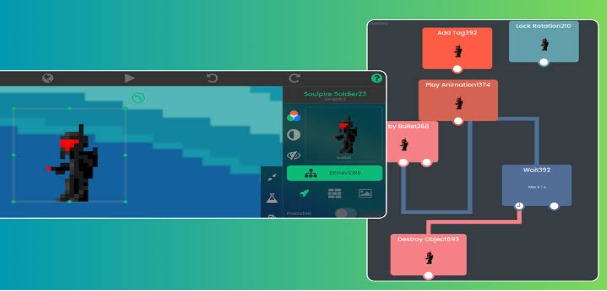
Have you ever had a game idea that seemed really cool in your head, but you couldn’t build it because you didn’t know how to program? You’re not alone. For many beginners, game development can feel intimidating at first, especially because of the technical jargon and complicated development environments.
Fortunately, you don’t need programming knowledge to start creating games today. Visual editors, drag-and-drop mechanics, and no-code platforms help beginners turn rough ideas into playable experiences without spending months learning to code. Astrocade is an AI-powered gaming platform that makes game creation more accessible, allowing users to explore their creativity and bring their game ideas to life.
Easy Game Creation
For simplified game development it is best to have your first project be something small. Instead of trying to make a massive open world game, you could make a simple platformer, puzzle game, racing game, or even a simple arcade game. A small project gives you a chance to learn the concepts you’ll need like movement, levels, characters, and goals without being overwhelmed.
And as with many parts of game development, planning your game in advance before you open up any development software can make the process easier. What will the player do? You know what is the objective of the player, what is the end of the game. Even a really rough guide can save you time and keep you on track as you work, so they are worth the extra work.
No-Code Game Making
No-code game development is for people who want to make games without having to write programming code in the traditional sense. Most tools aimed at beginners have visual editors with drag and drop functionality to place objects, edit their properties, create levels, and manage interactions through user-friendly menus or visual workflow systems. Play Test is a feature that lets you take the game design for a test drive, and get a feel for how the pieces of a game snap together.
So you can start with basic features and then build from there once you get more comfortable. Let’s say you want to move a character across a screen to begin with. Then you can go on and add obstacles, scores, sounds, enemies, or a very basic win condition. This is the speed of how a tutorial can make creating games seem a lot less scary and at the same time provide the first lesson.
Build Games Easily
A good way to do all this is to focus on one thing at a time. Working on characters, menus, enemies, levels, sound effects and complex mechanics at the same time is a good way to get overwhelmed. Start with the gameplay itself, and then polish it gradually.
Templates and premade assets can help hobbyists move faster. Rather than starting from the beginning, you can make use of the graphics, sounds, backgrounds, or game pieces that are already made. When you have your simple game working, you can replace these elements with your own art and create a look that is uniquely yours.
Simple Game Development
Much of simple game development is just knowing how things fit together. So the player hits a button, the character animates, a thing animates, the game does something to the player. You don’t need to be aware of all the technicalities right now to start enjoying these interactions.
Testing is another significant aspect of development. You want to play your game a lot, and look for anything that confuses you, or makes the game too hard, or just doesn’t work the way you expect. Another person play it. The newbie to your game can start finding holes in your design you might never see, simply because you already know how your game works.
Create Without Coding
Developing a game without coding doesn’t mean you have to avoid technical concepts altogether. You just learn them a bit at a time as you work on a project that’s important to you. Beginners can also take advantage of visual scripting and visual development systems, which serve as introductions to concepts like conditions, events, variables, and game logic without scaring them away.
As your projects grow in scale, you might want to pick up programming yourself, anyway. At that point, you’ll have picked up a lot of the basics of making games that can help make coding easier for you to understand. What begin as a tiny little idea can end up leading to some pretty advanced game design and development.
Getting Started With Your First Game
Start with something you can get done. A small game like a simple one-level game with a few mechanics is almost certainly going to be more productive for learning than a giant project that never sees the light of day. When you finish one, it teaches you what you need to do and what you need to work on.
Keep your first project very simple in terms of scale. Maybe you’re designing a character who needs to reach the end of a level, or gather a certain number of items, or survive for a set amount of time. When the crude version is finished, you can add one fresh feature after one new feature, testing as you go along prior to adding the next.
Common Mistakes Beginners Make
A common error is to begin with a project that is too large. New developers are always eager to create massive multiplayer games, or incredibly large maps, or hyper-realistic graphics before they’ve even learned the basics. Such ideas can be enticing, but they could also add complexity that might not be needed to the learning curve.
Another trap is to fret over perfection. Your first game is almost certainly going to suck, and that’s okay. It’s a project you can learn from. Every bug, clunky mechanic and half-implemented feature can teach you something new that will help you with your next game.
Keep Learning Through Practice
You don’t have to know everything before you get started. If you were to try to learn all the aspects of the game development process first, it can make that path seem like it has no end. Learn what you need to know for the project at hand, use it, and move on to the next thing.
Tutorials, documentation, beginner communities and small practice projects can all help you improve. Rather than just pasting a sample, edit it. When you know why it works, you’ll be much more successful using the concept in your own games.
Conclusion
You don’t need to start game development with complex code or years of technical knowledge. Many tools are available for beginners, small projects, and creative experimentation, helping you turn your ideas into playable experiences. If you want to create a game like Crab Game, start by understanding its core gameplay, then gradually add new features and improve your skills with each project.
Your first game doesn’t have to be perfect! You just need to complete enough of it to learn valuable lessons and gain the confidence to start your next project. Think small, experiment with the tools you have, and most importantly, keep creating. You never know what amazing game you might build next!
FAQs
Can I make a game without knowing how to code?
Yes. A lot of game development tools and engines are focused towards beginners and enable the creation of games using visual editors, drag-and-drop components, or no-code solutions. You can start out with basic mechanics and work your way up to more advanced stuff.
What is the easiest type of game to make?
Simple 2D platformers, puzzle games or arcade games are a decent choice for beginner devs. Mechanics in these games are usually simpler, and they can help you learn the fundamentals of game design without bombarding you.
How long does it take to create a simple game?
The amount of time it takes depends on the size and features of the game along with your skill level. A simple app can be made in a matter of days, but more complex apps with multiple screens, characters, sound effects, and other advanced functionality can take significantly more time.
Do I need expensive software for making games?
No. There are user-friendly game making tools that are free or very inexpensive to use. When you’re just starting out, get a sense of the fundamentals of development, not blow a lot of money on software or assets.
Is making games a good way to learn game development?
Making tiny mini-projects gives you experience with game mechanics, level design, testing, turnaround, etc. Instead of developing games for just reading about game development, you’re learning by doing you’re making something you can actually play and then go back and improve.